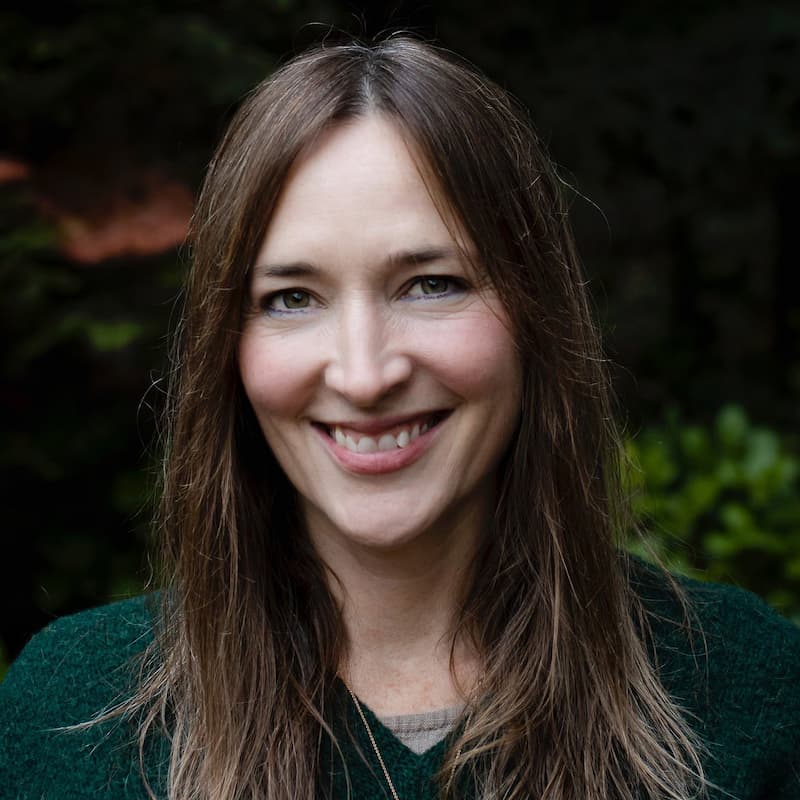
Cuff, Lindsay
Associate Professor of Teaching (jointly appointed with Land and Food Systems)
Department of Forest and Conservation Sciences
Office: MCML 191
I am a writer and a teacher of writing. My background and education is in creative writing and social and environmental communications, and I am passionate about inspiring the next generation to tell stories that drive transformation and change .
Teaching
My teaching practice focuses on discipline-specific writing and communication. I am the curriculum coordinator of the first-year undergraduate scholarly writing courses in the Faculties of Forestry & Environmental Stewardship and Land & Food Systems and I teach within two cohort programs: the Bachelor of Indigenous Land Stewardship program and Land One. The courses I currently teach at UBC are:
- NRES 150 – Scholarly Writing & Argumentation
- LFS 150 – Scholarly Writing & Argumentation
- FRST 545 – Technical Communications II: Scientific Writing
I am also a frequent guest lecturer in:
- NRES 110 – Integrative Seminar
- Cons 452 – Global Perspectives
Educational Leadership
I pursue EL as an inherently collaborative activity—I collaborate with students and colleagues across disciplinary boundaries to deepen our impact on teaching and learning, increase equity within classrooms and institutional structures, and actively respond to the Truth and Reconciliation Commission’s Calls to Action.
My specific areas of interest and impact in Educational Leadership include:
- Contributions to the practice of teaching and learning literature in the form of Open Educational Resources
- Curriculum development and renewal
- Advancing interdisciplinary collaboration in teaching and learning
- Empowering, training, and mentoring others
Research
My scholarly activity focuses on contributing insights into inclusive, accessible, and decolonial approaches to writing instruction in higher education. Specifically, I am interested in exploring how the use of creative, place-based pedagogies can support undergraduate and graduate student writing and scholarly identity development within a STEM context, and how the exploration of student positionality can contribute to the broader goals of reconciliation and decolonization within higher education. I am currently co-authoring a paper exploring the impact of writing a positionality statement on first-year undergraduate science students.
Projects
Sustainability Across First-Year Core Curriculum: The Land One Experience (Co-Principal Investigator, Sustainability Fellowship, 2024-2026). An interdisciplinary project focused on co-developing integrated curriculum that weaves sustainability concepts through four first-year courses taken by the Land One first-year undergraduate cohort (Biology, Economics, Writing, and Integrative Seminar).
Flexible Hybrid Writing Instruction Throughout Undergraduate Curricula: Fostering Students’ Growth, Persistence, and Identity as Writers in Scholarly Communities and Beyond (Principal Investigator, Large Teaching and Learning Enhancement Fund Transformation Project, 2023-2025).
This project aims to strengthen first-year students’ foundation in scholarly writing and scaffold further development of writing skills throughout undergraduate curricula in Land and Food Systems and Forestry by i) transforming two multi-section first-year scholarly writing courses into hybrid learning experiences and ii) creating context-specific online learning modules for second-, third-, and fourth-year courses to provide ongoing scaffolded instruction in scholarly writing and argumentation.
Writing Place: A Scholarly Writing Open Textbook (Principal Investigator/Creator, Open Educational Resource Implementation Fund).
In 2022, I developed and created Writing Place—a free, online textbook for use in 18 sections of LFS 150 and NRES 150. To date, over 1000 students in LFS 150 and NRES have directly benefited from this resource and each month, it receives an average of approximately 1000 unique visitors from locations around the world, including Denmark, India, the US, Germany, and Indonesia. Writing Place contains 13 chapters, with Student Learning Goals, Questions for Reflection, and Key Take Away sections for each chapter; 97 illustrations; 29 HP5 interactive activities, and 10 Student Narratives.
Awards
Killam Teaching Prize, University of British Columbia, 2026.
UBC Open Educational Resource Impact and Excellence Award, University of British Columbia, 2025.
D2L Innovation Award in Teaching and Learning, Desire 2 Learn (D2L)/Society for Teaching and Learning in Higher Education, 2024.
Open Education Champion Award, UBC Alma Mater Society, 2022.
Open Education Champion Award, UBC Alma Mater Society, 2021.