While you can use the UBC Academic Calendar to view required courses for your degree program, it is recommended that you refer to the following Degree Requirement Info Sheets to plan your courses for each year, as these are more frequently updated and include more detailed information.
Please note that you will need to follow the degree requirement info sheet based on the year that you entered your program. For example, if you began your BSCN degree in 2019, you will need to follow the 2019 requirement sheet.
If you require an info sheet for a year earlier than 2018, please get in touch with Forestry Student Services at forestry.undergrad@ubc.ca. For those completing a dual degree in education, please get in touch with Forestry Student Services if you require more information about degree requirements.
Bachelor of Science in Forest Bioeconomy Sciences & Technology
In a world where it’s easier than ever to shut out dissenting opinions, surround yourself with like-minded people, and become insulated from the unfamiliar, the Faculty of Forestry & Environmental Stewardship has developed a successful program that does just the opposite – and students love it.
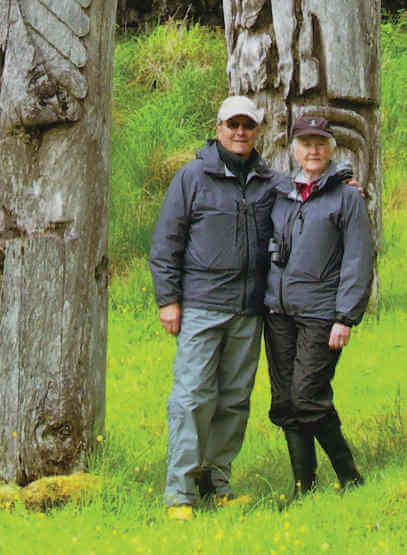
Gary and Louise Kenwood
The UBC Haida Gwaii Institute (HGI) offers third- and fourth-year students exceptional learning experiences in natural resources management, reconciliation studies, marine conservation, community resilience and more. The semester-long programs during the academic year allow students to earn credits while learning, living and volunteering in small, remote communities on Haida Gwaii, while the four-week summer sessions offer immersive classroom and field experiences.
Caitlin Laidlaw is a Forestry student who attended HGI in 2016. “Perhaps the most unique aspect is the integration of the students within the Haida community,” she says. “Where else in Canada would I be able to live on a First Nations reserve and get invited to community dinners and potlatches, and openly discuss how Canada and First Nations communities can work towards reconciliation?”
Joseph Moric, a third-year Forestry student, says that HGI “has allowed me to become more honestly open to different perspectives, different ways of knowing, and pushed me to understand the value of diversity not only in ecosystems but in people.”
HGI also gives students learning opportunities that are unavailable on UBC campuses. Third-year student Georgia Hall says, “Learning about ancient Haida village sites while actually being in Kuuna or hearing about the Lyell Island standoff of 1985 while staring at the Windy Bay Legacy Pole made the information relayed even more meaningful. I woke up every morning eager for class and excited for whatever unique adventure that day would involve.”
Over and over, students relate how the HGI experience gave them a new perspective. In some instances this has led to “light-bulb” moments, such as this one for Erin Stewart: “Our time at Tarundl Creek brought me to realize my passion for riparian ecosystem conservation and research of land use effects on salmon life cycles. I now hope to study this throughout a graduate degree.”
As enriching and beneficial as HGI is, it’s also expensive for students. The program fee is $4,000 for a semester and $1,600 for a summer session, above and beyond UBC tuition. On top of that there’s the cost of travel to and from Haida Gwaii, as well as accommodation and living expenses that are generally higher than usual due to the remote location.
To help bridge the financial gap for Forestry students in need, the Faculty has established a Travel Award program. With the help of donors, we would like to offer 12 or more Travel Awards each year to deserving students.
Gary and Louise Kenwood have supported forestry students for many years, initially through their award for Aboriginal students, and now through the Travel Awards program. They recently renewed their commitment to support two students for the next three years. “We have visited Haida Gwaii and have talked with students in the HGI Travel Award program” Gary says, “It’s clear to us that this program provides a valuable learning experience, with impacts that extend beyond academics into cross cultural understanding. Certainly, it’s important that we all support programs of this nature.”
Other donors have come on board as well. A private grant-making foundation funds four full semester grants each year, and UBC alumna Dee Rothwell will be supporting the first grant for summer session students, starting in 2020.
Larger than a full-grown humpback whale, the Haida Looplex X Canoe is a staggering 53 feet in length, suspended from the ceiling in the atrium of the Forest Sciences Centre.
One of 4 replicas of the “Lootas” (“wave-eater”) canoe, which was carved by Haida artist Bill Reid for the 1986 Vancouver Expo in a traditional Haida style from a single red cedar log, and later famously paddled up the Seine River to Paris—the Looplex X was donated to UBC’s First Nations House of Learning (FNHL) by Dr Martine J. Reid and Don Martin in 2011.
Due to years spent in drydock, the Looplex X required extensive renovations. Its hull was cracked in numerous spots and much of its wood was warped, broken, or rotting. The original artwork was also damaged beyond recognition.
Debra Martel, FNHL Associate Director, and Professor Rob Kozak, Head of the Department of Wood Sciences, partnered on the restoration which took place at the Centre For Advanced Wood Processing.
Hereditary Haida Chief and renowned artist James Hart oversaw the canoe’s repair and the artwork’s redesign with help from young Haida artists John Brent Bennett, Brandon Brown, Mary Hart, and Carl Hart, with woodwork by Lawrence Günther of the UBC Centre for Advanced Wood Processing. The renovations were completed over a 3-year period from 2012-15.
The illustrations on the canoe depict the story of Wasgo, which goes:
A young man living in Skidegate has a very mean mother-in-law who constantly belittles him. One day he decides to capture the Wasgo, a powerful half-wolf, half-orca creature that lives in an inlet near the village and takes its powers.
Wearing the Wasgo skin, he swims in the ocean at night and captures fish and other creatures to bring back and leave for his mother-in-law to find on the beach. The mother-in-law believes she has gained special powers and uses these gifts to pursue higher status in the village.
Because the young man is secretly hunting all night, when he gets back to the village he sleeps all day, so the mother-in-law calls him lazy and ridicules him even more.
One night, the young man tries to bring back 2 orcas and dies of exhaustion on the beach as he returns. His distraught wife, who has known his secret all along, opens the Wasgo’s mouth to reveal her husband’s identity to the entire village. The mother-in-law realizes the truth behind her newfound powers and status and dies of shame.
With permission from FNHL, and the Musqueam and Haida, the Looplex X was delicately installed in the atrium of the Forest Sciences Centre. The official installation ceremony was held on November 23, 2016.
As well as adding to the Indigenous presence on campus, the Haida Looplex X Canoe also serves as a symbol of the strengthening relationship between the Faculty of Forestry & Environmental Stewardship, the Haida, and First Nations.
“It will, for all who see it, be a living reminder of the persistence of Haida and Aboriginal culture and of Bill Reid’s legacy. For Aboriginal students and youth, it will be a recognition of Indigenous presence at the University, and will generate excitement, pride, and encouragement to succeed.”
– Linc Kesler, Former Director of the First Nations House of Learning
Credits: Bill Reid Looplex X Canoe Installation Ceremony, Bill Reid’s Looplex X Canoe Installed at UBC, A balancing act for project services: Installing the Haida Looplex X at UBC
Indigenous Art Series: Find out where you can view Indigenous art on campus and the story behind each piece by checking out the interactive map.