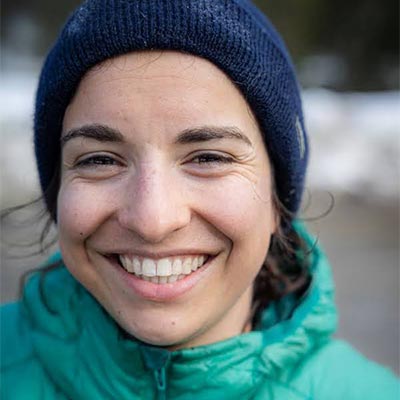
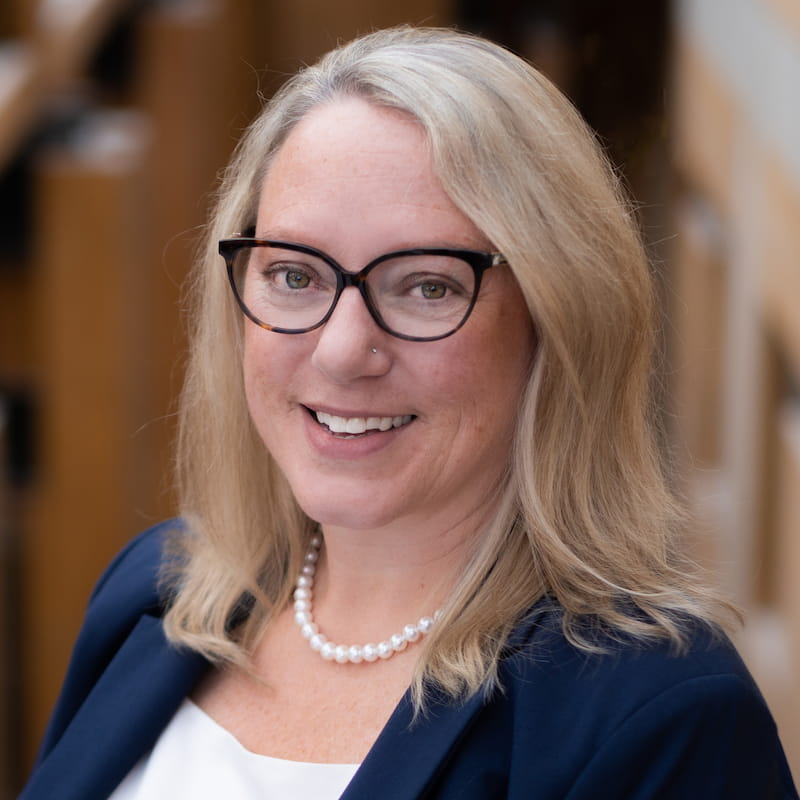
Yeganeh Asadian (BSc(Natural Resources Conservation)’07, MSc(Forestry)’10) is currently at the Vancouver Airport Authority as a Manager, Climate and Environment. Yeganeh volunteered as a mentor with UBC Faculty of Forestry & Environmental Stewardship Tri-Mentorship Program in 2024 and as a Speaker/Lecturer at the Industry Nights, Building a Sustainable World: Careers in the Green Economy in 2022.
UBC Forestry & Environmental Stewardship’s Tri-Mentorship Program is a unique program that provides the opportunity for students to connect with industry professionals. This program develops networking skills, communication and the confidence for entering the workforce.
Yeganeh shares why she decided to become a mentor, her experience being apart of this program and why it is important to her.
When I first stepped into a Canadian classroom, everything felt foreign—the language, the culture, the education system. Having moved to Canada just five years before starting university, I struggled to navigate this new world. I lacked a mentor to help guide me through the challenges of language fluency, adapting to the academic structure, and finding a sense of belonging. Those early years were marked by uncertainty and isolation.
It wasn’t until later in my career that I met mentors who profoundly shaped my professional and personal journey. Their guidance was more than just career advice—it was about human connection, shared experiences, and personal growth. They taught me that mentorship is not just about opening doors professionally but also about fostering confidence, resilience, and a sense of purpose. Their impact instilled in me a deep appreciation for the role of mentorship and a commitment to paying it forward.
That commitment led me to volunteer as a mentor with UBC Faculty of Forestry & Environmental Stewardship Tri-Mentorship Program in 2024 and as a speaker at Industry Nights: Building a Sustainable World—Careers in the Green Economy in 2022. These experiences allowed me to bridge the gap between academic learning and real-world application, helping students and emerging professionals find clarity in their career paths.
Through the Tri-Mentorship Program, I had the opportunity to connect with students, sharing insights from my journey and offering the kind of guidance I once wished I had. The most rewarding moments came when I saw mentees gain confidence, realizing they had the skills and knowledge to pursue their ambitions. Similarly, speaking at Industry Nights was a powerful experience—it was inspiring to engage with individuals passionate about sustainability and to witness their excitement about the possibilities within the green economy.
But mentorship, to me, is not just about structured programs or formal engagements. Throughout my career, I have made it a priority to support anyone who seeks guidance—whether through a scheduled meeting, a casual conversation, or a quick message seeking advice. I have never turned anyone away because I understand what it feels like to navigate a path without a guide.
Mentorship is about lifting others as we climb, creating a cycle of support that strengthens both individuals and communities. The lessons my mentors imparted to me continue to ripple outward, shaping the next generation of leaders in forestry, sustainability, and beyond. In every mentoring moment, I see an opportunity to give back, to empower, and to ensure that no one has to walk their path alone.
Interested in getting involved in tri-mentorship? Applications are still open!
UBC Forestry & Environmental Stewardship wishes to congratulate Cissy Zhang on being awarded UBC’s Spring 2025 Partnership Recognition and Exploration (PRE) Fund.
About Cissy
Cissy Zhang is a Master of Science student in the Department of Forest Resources Management and a member of the Indigenous Ecology Lab at UBC. Her project, Sasiwala: Centering Kwiakah Knowledge Systems in Regenerative Forestry, supports a two-day gathering bringing together Kwiakah First Nation members and UBC co-researchers to build relationships and share knowledge before beginning a Kwiakah-led forestry project. Held in Campbell River and on the Nation’s Core Territory, Sasiwala emphasizes land-based learning, storytelling, and collaboration grounded in both Indigenous knowledge and Western science. PRE funding supports an Indigenous facilitator, recommended by Dr. Jennifer Grenz, to guide respectful dialogue, as well as a videographer to document the gathering for future community and research use.
About the PRE Fund
The Partnership Recognition and Exploration (PRE) Fund celebrates inspiring initiatives that bring together UBC students, faculty, and staff with community partners to address shared goals across a wide range of themes.
By supporting the development of reciprocal, ethical, and impactful partnerships, the PRE Fund reflects UBC’s ongoing commitment to community-led engagement, experiential learning, and socially responsible research and teaching.
Each year, the PRE Fund provides up to $1,500 to help bridge resource gaps and strengthen new or existing university–community collaborations. Since 2017, it has supported over 445 partnerships with more than $667,000 in funding. Approximately 40% of this support has gone to IBPOC-led projects, including 25% led by Indigenous partners.
Meet Charlotte! Charlotte is a fourth-year in the Natural Resources Conservation program – Science and Management major. This summer, Charlotte is working as a Canvasser for the Wilderness Committee. She shares how her degree in conservation has helped her with this role, the skills she has developed and what she has enjoyed the most about this position.
This summer I had the opportunity to work with the Wilderness Committee, an environmental charity for protecting species at risk, old growth forests, among other conservation issues in BC. My job entails going door to door, connecting with previous donors as well as canvassing for new donors.
I am responsible for being knowledgeable about current environmental issues the Wilderness Committee is involved in and being able to successfully communicate these topics to individuals with a variety of perspectives. Studying conservation has enabled me to do this successfully as these subjects directly relate to what I have learned in lectures. Having this foundational knowledge helps to facilitate these conversations while expanding the depth of my understanding of conservation and environmentalism.
Working in this position, I have developed my interpersonal skills by being able to successfully discuss complex and controversial topics. With this job being quite physically and emotionally demanding at times, in regards to working in outdoor conditions and encountering lots of rejection, I have improved my resilience and perseverance.
Developing this grit and ability to communicate will definitely benefit me in future jobs. Being responsible for accounting for all of the donations I receive, I have honed my attention to detail and organizational skills.
My favourite part about this job is definitely connecting with those in my community over environmental issues. I have really enjoyed many of the conversations I have gotten to have with individuals all over Vancouver. Being able to connect with others on these topics that I feel so passionately about has been a wonderful experience. Having the opportunity to learn more in depth about different environmental issues has been a great way to expand my knowledge in the field of conservation.
I am a Registered Professional Forester with experience in landscape-level planning and forest operations across various regions of British Columbia. I hold a BSc in Forest Ecology and Management (UNBC) and a MSc in Forestry (UBC), where my research focused on modelling stand susceptibility to Douglas-fir beetle. As part of the Malcolm Knapp Research Forest team, I carry out strategic and landscape-level planning. Within the Faculty of Forestry & Environmental Stewardship, I contribute to various programs through teaching and coordination. My interests lie in disturbance ecology and helping others explore the complex dynamics of forest ecosystems and management.
The Advanced Renewable Materials Lab is led by Dr. Scott Renneckar. This lab works with plant based polymers and a range of other natural materials to create sustainable products for a variety of applications.
Raewyn shares what it is like working in a lab, what a typical day at work is like and the unique opportunities this position has provided her with.
In this role, I get hands on experience researching renewable biomaterials, preparing samples, and testing the properties of the materials I create. One project I’m currently working on involves developing foams without the use of fossil fuels.
Through my degree, I’ve taken courses in organic chemistry, polymer science, and applied biotechnology, which provide a strong foundation for many of my daily tasks. My laboratory classes offered hands-on experience, allowing me to practice essential lab techniques and procedures. I’ve also been able to apply research skills, particularly in literature review and data analysis, developed through coursework to real world scenarios.
I’ve had the opportunity to work with a variety of equipment in the lab, including ATR, DSC, DMA, and a rheometer. Building on this, I’m learning how to interpret, analyze, and compare results and raw data generated by these instruments.
A typical day in the lab involves meeting with my supervisor to discuss tasks for the day, planning my schedule, preparing and analyzing samples while updating my lab book, and attending lab meetings to share progress on current projects. The best part of this job is that it allows me to gain meaningful, hands on experience that I can apply both in the classroom and in my future career. I also love having the opportunity to explore scientific topics that interest me and to follow my curiosity in a field I’m passionate about.
Taya Baerg is a third-year student in the Natural Resources Conservation at UBC Forestry & Environmental Stewardship. This summer, Taya is working as a Himalayan Carnivore Research Assistant at UBC’s Gaynor Lab. This position is apart of the WorkLearn program.
In this Q&A, Taya shares her experience working in this position, the skills she has developed and what a typical day at work looks like for her!
What are your role and responsibilities in your summer position?
My role in Gaynor Lab is a Work Learn position – it is as much my responsibility to learn as it is to work! As for the ‘work’ portion, my day-to-day responsibilities involve organizing and annotating images collected from camera traps in Shey Phoksundo National Park, Nepal, to support ongoing research studying human impacts on two of the region’s top predators: wolves and snow leopards. As for the ‘learn’ portion, I participate in meetings and discussions in which my labmates and I gain insight into each others’ research and critically read relevant scientific literature.
How has your degree prepared you for this role?
My degree in forestry has helped me in developing many skills crucial for this role, including interpreting data and scientific communication. My courses have introduced me to a number of concepts that have amplified my understanding of the lab’s research, such as niche partitioning and human-wildlife conflict. In particular, CONS 454 (South Africa field school) introduced me to the world of camera traps, inspiring me to further pursue work in this field.
What skills have you developed from this role?
This role has immensely strengthened my skills in data management and statistical analysis. I have had the opportunity to explore ways in which GIS and R can be used to manage data and synthesize results.
What does a typical day at work look like for you?
A typical day involves putting on some good tunes and looking at thousands and thousands of images of leopards, wolves, people, livestock, and so much more! It also involves collaborating with my supervisor and labmates to discuss our findings and overcome difficulties with the data.
What is your favorite part of this job?
The highlight of my job is hearing about what everyone else in the lab is doing! The lab’s research varies in terms of topic, location, and study subject – from bobcat range shifts here in BC, to ungulate niche partitioning in Mozambique, to predator-prey interactions in California. It is a privilege to be immersed in such diverse studies among such a passionate team
Join Elder Leonard Williams for a hands-on cedar bark harvesting demonstration and cedar weaving project, open to all UBC faculty, staff, and students. While the event is primarily aimed at STEM faculties as part of regular EDI.I programming, anyone interested—especially those enrolled in the IDEAL or Cascades of Change programs—is welcome to attend. This experiential opportunity fulfills Stage 2 requirements for both programs and offers a unique chance to learn directly from Indigenous knowledge and practice.
Isabelle Roth is a fourth-year student in the Natural Resources Conservation program – Science and Management major at UBC Forestry & Environmental Stewardship. This summer, Isabelle is working as a Summer Seed Associate at Bayer CropScience.
She shares her experience thus far, how her time and coursework at UBC Forestry & Environmental Stewardship have prepared her for this role and what she has been working on this summer!
As a Summer Seed Associate at Bayer CropScience in Cranbrook, I’ve developed a wide range of skills related to sustainable agriculture. My main responsibilities include maintaining drip irrigation systems, managing the quality of various canola varieties, supporting soil fertility, and conducting field assessments to monitor crop health.
This role has shown me how closely forestry and conservation connect with sustainable agriculture—through work in soil analysis, plant biology, data collection, and species identification. It’s also given me the chance to explore a diverse range of ecosystems throughout the East Kootenays.
One of the highlights of my summer has been working with leafcutter bees to enhance pollination across our fields, as well as installing soil and atmospheric sensors to monitor changing field conditions. Another favourite part has been operating heavy-duty farm equipment and driving tractors—getting hands-on experience with the machinery that makes large-scale agriculture possible.
Bayer CropScience’s motto, “Health for all, hunger for none,” reflects the meaningful impact this work can have, and I’m grateful to be part of an effort that contributes to more sustainable and resilient food systems.
When: September 18, 2025 | 10:30-11:30 am (PST) Where: Online via Zoom
Online Micro-Certificates
Designed for working professionals, UBC Forestry & Environmental Stewardship’s wide array of programs offers an accessible opportunity to elevate your skills, engage with industry leaders and advance in your career. Delivered exclusively online, UBC Forestry & Environmental Stewardship’s micro-certificates are paving the way to providing quality, industry-aligned and accessible forestry education across Canada. Join one of the information sessions below to hear from the program director and past alumni to learn more.
August 21, 2025 | 10:30 am (PST)
Natural Resource Management: Comprehensive Strategies for Managing Natural Resource Environments and Systems
This session will cover the following micro-certificate programs:
With extensive experience in large-scale climate vulnerability assessments across different sectors and organizations, Dr. Andrews-Key brings her expertise in the development and implementation of adaptation, specifically as applied to business cases for adaptation across all sectors. She is passionate about exploring how we can bridge science, theory and action to provide students with the comprehensive and applied knowledge necessary to excel in their careers.
We are pleased to announce the UBC Forestry & Environmental Stewardship faculty members who have been awarded new NSERC and SSHRC grants this year. The NSERC Discovery Grant supports foundational research in the natural sciences and engineering, while the SSHRC Insight Grant honors excellence in the social sciences and humanities. Congratulations to the following recipients on their success in these highly competitive programs:
NSERC Discovery Grants
Cole Burton(Forest Resources Management) Caribou conservation and mammal community dynamics under top-down and bottom-up influences
Tzeng Yih Lam (Forest Resources Management) Particle Filtering in Forest Growth: Closing the Gap between Modelling and Sampling
Eliot McIntire (Forest Resources Management) Advancing predictive ecology within a changing world: improving inference, forecasts, and policy influence
Monika Fischer (Forest & Conservation Sciences/Botany) Elucidating the mechanisms of fire-response in fungi
Emily Cranston (Wood Science) Functional-by-design nanocellulose for sustainable bioproducts
Kwang Ho Kim (Wood Science) Advancing Universal and Greener Biomass Fractionation Technologies for a Circular Bioeconomy
Minghao Li (Wood Science) Developing next generation seismic resilient mass timber structures
Scott Renneckar (Wood Science) Recipient of NSERC Discovery Grant & Research Tools and Instruments Grant Biobased Polymer Engineering: Better Bonds via Deconstruction and Derivatization
Taraneh Sowlati(Wood Science) Optimization of forest-based biomass supply chains: considering sustainability, uncertainties and government policies
SSHRC Insight Grant
Hamish van der Ven(Wood Science) The Indirect Impacts of Internet Use on the Climate Crisis
Insight Development Grant
TahiaDevisscher (Forest Resources Management) Enabling equitable nature-based solutions for social-ecological resilience to climate change